Showing posts with label Education. Show all posts
Showing posts with label Education. Show all posts
Thursday, August 19, 2010
Management Theory Part 1: Attitudes and Perception, Written by, Christopher Lim
Attitudes are an important component of organizational behaviour. Formally defined, an attitude is a predisposition to respond in a positive or negative way to someone or something in our environment (Wood et al. 2006, p. 55). Attitudes have three components: cognitive, affect and behaviour. In organizations, attitudes are important because of their behavioural component. Attitude-behaviour relationship is likely to be much stronger if an attitude refers to something with which the individual has direct experience (Robbins and Judge 2007, p.69).
An employee faced with the problem of not meeting his goal of getting a promotion may create a problem for him. One theoretical framework – the exit-voice-loyalty-neglect framework may be helpful in understanding the succeeding behaviour of this employee. Hirschman asserted that, when confronting workplace problems, people’s two courses of actions were:
(1) leave the organization, “exit”, or
(2) stay and express their displeasure, “voice”.
Whereas both exit and voice behaviours can send a similar message to the organization, causing it to improve, voice is the more difficult option (Hirschman 1970).
Those with greater loyalty are more likely to stay and try to change the organization from within. This is particular true if they believe that their efforts have the power to influence organization (Hodson 2001). Withey and Cooper (1989), building on Hirschman’s original model and later work by Rusbelt et al. (1988), identify four options for dissatisfied workers: exit, voice, loyalty, and neglect.
They define loyalty as remaining with the organization and supporting it.
Neglect is characterised by maintaining formal ties with the organization but limiting contributions to a minimum. Robbins and Judge (2007) characterized neglect as passively allowing conditions to worsen, including chronic absenteeism or lateness, reduced effort, and increased error rate.
It is assumed that job satisfaction determines an employee’s organizational behaviour (OCB). Satisfied employees would seem more likely to talk positively about the organization, help others, and go beyond the normal expectations in their job (Robbins & Judge 2007, p. 84). OCB is an individual voluntary behaviour that the organization’s formal reward system does not directly recognize. The accumulation of OCB also advances the successful operation of the organization (Fodchuck 2007, p.29).
When each individual see an event unfolding, they will interpret what they see, and that interpretation is heavily influenced by the personal characteristics of the individual perceiver. Personal characteristics that effect perception include a person’s attitudes, personality, motives, interests, past experiences, and expectations (Robbins & Judge 2007, p. 131).
When a manager makes a decision to promote one employee over another, they might have perceived the neglected employee to have certain negative attribute which resulted in the decision. People use shortcuts in perceiving and interpreting what others do. The Halo effect is when one attribute is used to develop an overall impression of the person (USQ, Mgmt5000, p. 35).
The most relevant application of perception is the issue of how we perceived people. The attribution theory can explain how colleagues and managers interpret the motives of each individual’s subjectively perceived behaviours.
Basically, the theory suggests that when we observe an individuals’ behaviour, we attempt to determine whether it was internally or externally caused. Internally caused behaviours are those that are believed to be under the personal control of the individual. Externally caused behaviour is seen as resulting from outside causes.
In self-serving bias (Krusemark 2008), the employee might blame his failure to get the promotion on an unappreciative and incompetent manager instead of his own shortcomings.
Reference:
1. Robbins, SP & Judge, TA 2007, Organizational Behaviour: Twelfth Edition, Pearson Prentice Hall, USA.
2. Fodchuck, KM 2007,’ Work Environments That Negate Counterproductive Behaviors and Foster Organizational Citizenship: Research-Based Recommendations for Managers’, The Psychologist-manager journal,Vol. 10 Issue 1 ,pp.27-46,
3. Wood, J, Zeffane, R, Fromholtz, M, Fitzgerakd, J 2006, Organizational Behaviour: Core Concepts and Applications First Australasian edition, Wiley, Australia.
4. Robbins, TL, Summers, TP, Miller, JL, Hendrix, WH 2000, ‘ Using the group-value model to explain the role of noninstrumental justice in distinguishing the effects of distributive and procedural justice’, Journal of Occupational and Organizational Psychology, Vol. 73 Issue 4, pp. 511–518,
5. USQ MGT5000, 2009, ‘Management and Organisational Behaviour: study book’, University of Southern Queensland, Toowoomba.
6. Hirschman, AO 1970, Exit, voice and loyalty: Responses to declines in firms, organizations, and states, Harvard University Press.
7. Hodson, R 2001, Dignity at work, Cambridge University Press.
8. Withey, MJ, Cooper, WH 1989,’Predicting Exit, Voice, Loyalty, and Neglect’, Administrative Science Quaterly, Vol. 34, pp. 521-539,
9. Krusemark, EA, Keith, CW, Clementz, BA 2008, ‘ Attributions, deception, and event related potentials: An investigation of the self-serving bias’, Psychophysiology, Vol. 45 Issue 4, pp. 511-515


Wednesday, August 18, 2010
Burger Wars: A Promotions Opportunity Analysis. Written by, Christopher Lim
Part 1: Burger King Communication Market Analysis
Introduction:
The following paper conducts a communication market analysis for Burger King. The paper will first analyse Burger King’s marketing communication strengths and weaknesses. Secondly, from a communication perspective, it will analyse the opportunities and threats present in Burger King’s external environment. The communication market analysis will specifically examine five areas: competitors; opportunities; target markets; customers; product positioning.
Competitors:
The main competitors of Burger King are, McDonald’s, Sonic, Wendy’s and Carl’s Jr.
The main competitor and leading the group in terms of spending on advertising and marketing is McDonald’s (Schlosser 1998). McDonald's blanketed the market with dollar deals in spring 2009 while Burger King stuck with ads that wooed its male "superfans"--and alienated thousands of parents (Nanette 2009). Due to this missteps results show that there was 7% rise for McDonald's as Burger King revenues remained weak (Nanette 2009).
Wendy's uses cross-platform marketing via AOL Time Warner, and launched ad effort through the Vidal Partnership, New York for its premium salad product and increased its sales month-on-month after (MacArthur 2003).
Carl’s Jr. in 2009 promote through ads, social media and press events that their new menu item Big Carl was the girthiest and biggest burger compared to Big Mac with the same message through those various media (Ebenkamp 2009).
Sonic message is very clear on their drive-in concept. They used various media including TV ads, internet web sites and via social media Youtube to bring across the message of drive-in to Sonic (SCA 2010).
Opportunities for Burger King:
Burger Kings’ could focus on the Gen Y group for their products. These are the consumers born between 1980 and 1994. In US, Gen Y-ers represent around 70 million people and spend about $187 billion annually (Kumar and Lim, 2008). Gen Y-ers are often early adopters of new technologies and extensive users of the internet (Kumar and Lim 2008, p. 570). Burger King may communicate through new media such as internet to address this group. Generating viral video and posting it in. In 2004, when Crispin Porter + Bogusky's "Subservient Chicken" video for Burger King's TenderCrisp chicken sandwich got hundreds of millions of visits, an ad created for the Internet with a reach far beyond what TV could offer--and all at a fraction of broadcast's high prices (Wassermann 2009).
Target Markets:
Target market for Burger King can be based on demographic segment and even geographic segment. Demographic segment target the different age group. The major target market is children. However, in their communication, Burger King should target the women or mothers of these children. Another target market may be working male from 24 to 49 years old who are working mainly in offices. These groups eats lunch during their lunch break and are looking for a bigger serving of burgers which can filled them up for the rest of their work day. Another target segment is working woman whom are looking for healthier alternatives for their lunch during office days. They may want salads in their menu, healthier menu of sandwiches which are all found in Burger King’s existing menu. Being charbroiled instead of fried, Burger King can target this busy women with specific ads focusing on the healthier attributes of their sandwiches.
Customers:
Kids represent an important demographic to marketers because they have their own purchasing power, they influence their parents' buying decisions and they're the adult consumers of the future. The main message targeting this segment is to make a product cool. Buzz, or "street marketing," as it's also called, can help a company to successfully connect with the savvy and elusive teen market by using trendsetters to give their products "cool" status. Buzz marketing uses word of mouth to spread the message (Hughes 2005) and using the coolest kid to tell you about their experiences in their favourite burger joint is a powerful tool.
It has been shown that during the economic downturn where a number of people lost their jobs. Sales at fast-food chains have slowed precipitously following those months. As more people lose their jobs, fewer workers mean fewer consumers needing to eat lunch outside of their own kitchens (Edwards 2009). Thus, when the economy picks up and hiring increases demand for fast food increases for lunch. This also applies to breakfast meals for people on their journey to their workplace for drive-thru outlets will benefit most, specifically, "the adult travelling to work” (Gray and Steven 2006).
The new growth target is a Gen X mom who prides herself on delivering a "wholesome, delicious" meal to her family (Evans 2010). For this group a more health-focused menu items and messages on a quick and healthy meal are appropriate.
Burger King’s core customer group is the 18 – 34 year old male (Nannette 2009) and they have to be wary not alienate but promote to these other groups mentioned in any ad campaign.
Product Positioning:
Burger King concentrates on a narrow product positioning. Burger King opted for a hamburger-focused advertising positioning. Translating this positioning into advertising campaign, it focuses on Burger King's most popular product: the Whopper. Taste test research conducted by Burger King indicated that consumers preferred the grilled taste of the beef and condiments found in the Whopper more than McDonald's chopped condiments and fried Big Mac. In addition, as McDonald's decided to continue building their generalist advertising approach, Burger King adopted an aggressive tactical strategy. All hamburger-focused promotions featured an aggressive price point (Sansom and Crawford 1995).
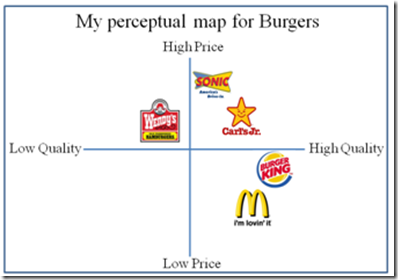
Burger King’s product position focused on giving consumers high quality with low price.
Part 2: Burger Chains Target Market
For Burger King, the 18 to 34 age segment was identified as the target group that could have the largest sales potential. Research indicated this age group frequented fast food restaurants more often than any other age group, and also represented the highest average restaurant sales receipts. In addition, this target group, as a result of its dissatisfaction, seemed most likely to be receptive to Burger King differentiating itself from McDonald's universal strategy.
In terms of media, this group could be easily targeted because of its selective media habits. This group watched specific television shows, watched specialized networks, listened to specific radio stations and frequented specific establishments (Sansom and Crawford 1995).
McDonald’s already had a well established name and a loyal base of customers. To expand, they can target health conscious people. By offering healthier versions of established menu items, expanding product depth they target health conscious customers (Jorgensen 2006). There are many reasons why a company such as McDonald’s would do this. One reason is that the traditional customer base of children (their main target market) has started to age and mature. Since they have reached a majority of them, there are not many more possibilities of growth in their current market. In order to continue growing McDonald’s needs to be continually looking for new markets to develop (Lamb, Hair & McDaniel 2006). With the increasing awareness of obesity and unhealthy diets in the U.S. McDonald’s is losing a large body of customers such as young children, women, and health conscious families.
Carls’s Jr target market is the 18- to 34- year age male demographic group. Their 100% Angus Beef burger cost half (Laermer 2008) of other offerings and cater for those that love a real beef burger in their meal. The main item though for this target market is the new menu item introduced to compete against McDonald’s. Their Big Carl burger is touted to be hefthier and bigger than the Big Mac (Ebenkamp 2009), enticing these males to switch over.
Sonic being the largest U.S chain of drive-in restaurants (Marrigan 2010) should focus on working adults on private transport. This also applies to people on their journey to/from their workplace where drive-in and drive-thru outlets will benefit most, specifically, "the adult travelling to work” (Gray and Steven 2006).
Wendy’s grilled chicken salad and chicken sandwiches menu is targeted towards figure conscious female. Their main target is the 24 – 49 year age female demographic group. The proliferation of women entering the workforce (Schlosser 1998) means that they are unable to prepare healthier calorie-less meal for lunch. Wendy's continues its practice of promoting chicken sandwiches with distinctive flavors. All are aimed at giving burger buyers another choice to keep them from straying to a chicken or pizza place (Petrecca and Kramer 1999) such as KFC or pizza hut.
Part 3: Communication Budget
A communication budget can be prepared in a number of different ways.
McDonald’s promotional budget should be derived using the percentage of sales method (Clow and Baack 2010, pp. 120). McDonald’s revenues for 2010 came in at USD5.95 billion (Herer 2010). This makes McDonald’s the world’s largest hamburger chain (Herer 2010) after Burger King and Wendy’s. Thus, by deriving their budget from sales, allows McDonald’s to have a huge promotional budget far surpassing Burger King’s. In 2008, McDonald’s marketing budget was a whopping USD1.7 billion (York 2008).
Having been outspent by McDonald’s and even Wendy’s in their advertising campaign (Samsom, Malley & Barham 1995) it would be appropriate for Burger King to derive their promotional budget from an “Objective and Task Method”(Clow and Baack 2010). Rather than try to match the competition's multi-product advertising strategies, the promotional budget should be spent on a single strategy to focus on Burger King's flagship product, the Whopper. Rather than being heavily outspent on television, Burger King could concentrate its spending on outdoor advertising, giving it a medium that it could dominate (Sansom, Malley & Barham 1995). To prepare this type of communications budget, management lists all of the communication objectives to pursue during the year and then calculates the cost of accomplishing each objective. The communication budget is the cumulative sum of the estimated costs for all the objectives (Clow and Baack 2010).
The most humbling thing in the restaurant business is to compete with McDonald's advertising budget (Dougherty 1987). Wendy’s budget in 1987 was roughly 10 times smaller than McDonald’s (Dougherty 1987). Wendy’s should use the meet-the-competition method of budget allocation. Wendy’s have to focus on keeping their market share (Clow and Baack 2010) from Hardees (Carl’s Jr) and Sonic.
Carl’s Jr being one of the smaller five burger chain can only compete with an extremely small communication budget. The payout planning method is more suitable to Carl’s Jr when planning their communication budget. They have to establish their budget from a ratio of advertising to sales or market share. Thus, this method allows Carl’s Jr to allocate a greater amount in the early years to yield payouts in later years (Clow and Baack 2010).
Sonic may apply the “what we can afford” method. The drawback is that it may give the wrong intention that management are not focus on their marketing activities (Clow and Baack 2010). However, being the smallest of the lot and with limited finances, this approach can be use. With little budget to battle rivals across segments, dayparts, menu platforms and pricing schemes, Sonic can boost average unit sales by boosting traffic, check size and frequency of visits. Today, the number of times a customer frequents a chain each month matters as much as how much they spend each time, so free product presents an opportunity to convert the curious into loyalists. Sonic are giving our free floats to get people to visit more times a month (MacArthur 2007).
Part 4: How Carl’s Jr can compete against MacDonald’s.
Carl’s Jr without large national ad budget as compared to McDonald’s should rely more on displays and attractive packaging (Clow and Baack 2010, p.66). Packaging of the food must accommodate the way consumer use the product which include food that are fast, convenient, portable and fresh. It was found in a consumer survey that what were more important than price, convenience, and brand names were taste and freshness of the foods. It is thus imperative to have excellent packaging to maintain freshness as consumers were more likely to switch to other brands once they have experienced inferior packaging (Clow and Baack 2010, p.68).
The communication strategy that Hardees or Carl’s Jr chooses will provide them the long-term direction for all their marketing activities (Clow and Baack 2010, p. 123). That strategy has to focus on competing with the leader of the group McDonald’s with an annual marketing budget USD1.7 billion back in 2008 (York 2008). Carl’s Jr.s’ objective then is to go head-to-head against their main item, the Big Mac. With this the strategy is formed to compete directly with the Big Mac with the introduction of Carl’s Jr. Big Carl. Carl’s Jr. has nowhere near the number of locations, sales, or market share of McDonalds its major competitor (Macarthur 2005).
Having lower sales means that Carl’s Jr. has less communication budget. The core demographic market for Carl’s Jr. is the 18- to 34-year-old men (Macarthur 2005). Thus, Carl’s Jr together with their parent company CKE restaurants has to juggle spending of this small budget on media advertising, trade promotions and consumer promotions focusing on this core customer segment to bring the Big Carl message across.
A low cost method of advertising are via the internet and social networking sites which Carl’s Jr. can take advantage of. CKE Restaurants unleashed videos where viral video stars were invited to rift on the sizes of the chains' burgers versus McDonald's in the campaign, which went live on Facebook, YouTube and other social sites in Sept. 2009. Over the next week, McDonald's took "a colossal value perception nosedive with adults 18+," where McDonald's value score was cut to less than half, while Carl's Jr.'s score doubled during the period (Ebenkamp 2009).
It is critical that Carl’s Jr.’s communication strategy mesh with its overall message and be linked to the opportunities identified (Clow and Baack 2010, p. 125). To link messages targeting their core demographic group, Carl’s Jr. have to have tactics to support their strategies. Tactics include promotional campaigns designed around themes based on strategic objectives. One such tactic by Carl’s Jr. was in their "Drip Happens" campaign. Carl's pawed-after their target audience, the male of the species, whom has no desire to clean up after himself (Laermer 2008).
The introduction of the Big Carl burger was to take on a challenge against McDonald’s Big Mac. Promotions, ads and press events (Ebenkamp 2009) had all the same message by Carl’s Jr., that is, Big Carl burger is girthier, bigger and cheaper than McDonald’s Big Mac. The plan includes a new TV commercial, social media campaign via Facebook pages as well as YouTube and other social media sites; press event, all carrying these same messages.
Hardees or Carl’s Jr being smaller companies and not well known compared to McDonald’s, going the direction of co-branding is an excellent strategy (Clow and Baack 2010, p.65). Hardees or Carl’s Jr if successful in getting into such an alliance with another well known brand that is complementing their products, the relationship can build brand equity for Hardees or Carl’s Jr. In Carl’s Jr., ads campaign and promotions for Big Carl, they paired with Dry-cleaning and Laundry Institute, Laurel, Md., in endorsing the whole dripping ads. As part of this unlikely partnership, creative for the campaign will be featured on dry cleaning bags and static clings (Laermer 2008). They also released these ads together with Napkin Dispensers.
Carls’s Jr. has to maintain this focus communication strategy targeting their core demographic target market pulling in the resources of partners to make it effective to go against the big boys, McDonald’s.
References
Introduction:
The following paper conducts a communication market analysis for Burger King. The paper will first analyse Burger King’s marketing communication strengths and weaknesses. Secondly, from a communication perspective, it will analyse the opportunities and threats present in Burger King’s external environment. The communication market analysis will specifically examine five areas: competitors; opportunities; target markets; customers; product positioning.
Competitors:
The main competitors of Burger King are, McDonald’s, Sonic, Wendy’s and Carl’s Jr.
The main competitor and leading the group in terms of spending on advertising and marketing is McDonald’s (Schlosser 1998). McDonald's blanketed the market with dollar deals in spring 2009 while Burger King stuck with ads that wooed its male "superfans"--and alienated thousands of parents (Nanette 2009). Due to this missteps results show that there was 7% rise for McDonald's as Burger King revenues remained weak (Nanette 2009).
Wendy's uses cross-platform marketing via AOL Time Warner, and launched ad effort through the Vidal Partnership, New York for its premium salad product and increased its sales month-on-month after (MacArthur 2003).
Carl’s Jr. in 2009 promote through ads, social media and press events that their new menu item Big Carl was the girthiest and biggest burger compared to Big Mac with the same message through those various media (Ebenkamp 2009).
Sonic message is very clear on their drive-in concept. They used various media including TV ads, internet web sites and via social media Youtube to bring across the message of drive-in to Sonic (SCA 2010).
Opportunities for Burger King:
Burger Kings’ could focus on the Gen Y group for their products. These are the consumers born between 1980 and 1994. In US, Gen Y-ers represent around 70 million people and spend about $187 billion annually (Kumar and Lim, 2008). Gen Y-ers are often early adopters of new technologies and extensive users of the internet (Kumar and Lim 2008, p. 570). Burger King may communicate through new media such as internet to address this group. Generating viral video and posting it in. In 2004, when Crispin Porter + Bogusky's "Subservient Chicken" video for Burger King's TenderCrisp chicken sandwich got hundreds of millions of visits, an ad created for the Internet with a reach far beyond what TV could offer--and all at a fraction of broadcast's high prices (Wassermann 2009).
Target Markets:
Target market for Burger King can be based on demographic segment and even geographic segment. Demographic segment target the different age group. The major target market is children. However, in their communication, Burger King should target the women or mothers of these children. Another target market may be working male from 24 to 49 years old who are working mainly in offices. These groups eats lunch during their lunch break and are looking for a bigger serving of burgers which can filled them up for the rest of their work day. Another target segment is working woman whom are looking for healthier alternatives for their lunch during office days. They may want salads in their menu, healthier menu of sandwiches which are all found in Burger King’s existing menu. Being charbroiled instead of fried, Burger King can target this busy women with specific ads focusing on the healthier attributes of their sandwiches.
Customers:
Kids represent an important demographic to marketers because they have their own purchasing power, they influence their parents' buying decisions and they're the adult consumers of the future. The main message targeting this segment is to make a product cool. Buzz, or "street marketing," as it's also called, can help a company to successfully connect with the savvy and elusive teen market by using trendsetters to give their products "cool" status. Buzz marketing uses word of mouth to spread the message (Hughes 2005) and using the coolest kid to tell you about their experiences in their favourite burger joint is a powerful tool.
It has been shown that during the economic downturn where a number of people lost their jobs. Sales at fast-food chains have slowed precipitously following those months. As more people lose their jobs, fewer workers mean fewer consumers needing to eat lunch outside of their own kitchens (Edwards 2009). Thus, when the economy picks up and hiring increases demand for fast food increases for lunch. This also applies to breakfast meals for people on their journey to their workplace for drive-thru outlets will benefit most, specifically, "the adult travelling to work” (Gray and Steven 2006).
The new growth target is a Gen X mom who prides herself on delivering a "wholesome, delicious" meal to her family (Evans 2010). For this group a more health-focused menu items and messages on a quick and healthy meal are appropriate.
Burger King’s core customer group is the 18 – 34 year old male (Nannette 2009) and they have to be wary not alienate but promote to these other groups mentioned in any ad campaign.
Product Positioning:
Burger King concentrates on a narrow product positioning. Burger King opted for a hamburger-focused advertising positioning. Translating this positioning into advertising campaign, it focuses on Burger King's most popular product: the Whopper. Taste test research conducted by Burger King indicated that consumers preferred the grilled taste of the beef and condiments found in the Whopper more than McDonald's chopped condiments and fried Big Mac. In addition, as McDonald's decided to continue building their generalist advertising approach, Burger King adopted an aggressive tactical strategy. All hamburger-focused promotions featured an aggressive price point (Sansom and Crawford 1995).

Burger King’s product position focused on giving consumers high quality with low price.
Part 2: Burger Chains Target Market
For Burger King, the 18 to 34 age segment was identified as the target group that could have the largest sales potential. Research indicated this age group frequented fast food restaurants more often than any other age group, and also represented the highest average restaurant sales receipts. In addition, this target group, as a result of its dissatisfaction, seemed most likely to be receptive to Burger King differentiating itself from McDonald's universal strategy.
In terms of media, this group could be easily targeted because of its selective media habits. This group watched specific television shows, watched specialized networks, listened to specific radio stations and frequented specific establishments (Sansom and Crawford 1995).
McDonald’s already had a well established name and a loyal base of customers. To expand, they can target health conscious people. By offering healthier versions of established menu items, expanding product depth they target health conscious customers (Jorgensen 2006). There are many reasons why a company such as McDonald’s would do this. One reason is that the traditional customer base of children (their main target market) has started to age and mature. Since they have reached a majority of them, there are not many more possibilities of growth in their current market. In order to continue growing McDonald’s needs to be continually looking for new markets to develop (Lamb, Hair & McDaniel 2006). With the increasing awareness of obesity and unhealthy diets in the U.S. McDonald’s is losing a large body of customers such as young children, women, and health conscious families.
Carls’s Jr target market is the 18- to 34- year age male demographic group. Their 100% Angus Beef burger cost half (Laermer 2008) of other offerings and cater for those that love a real beef burger in their meal. The main item though for this target market is the new menu item introduced to compete against McDonald’s. Their Big Carl burger is touted to be hefthier and bigger than the Big Mac (Ebenkamp 2009), enticing these males to switch over.
Sonic being the largest U.S chain of drive-in restaurants (Marrigan 2010) should focus on working adults on private transport. This also applies to people on their journey to/from their workplace where drive-in and drive-thru outlets will benefit most, specifically, "the adult travelling to work” (Gray and Steven 2006).
Wendy’s grilled chicken salad and chicken sandwiches menu is targeted towards figure conscious female. Their main target is the 24 – 49 year age female demographic group. The proliferation of women entering the workforce (Schlosser 1998) means that they are unable to prepare healthier calorie-less meal for lunch. Wendy's continues its practice of promoting chicken sandwiches with distinctive flavors. All are aimed at giving burger buyers another choice to keep them from straying to a chicken or pizza place (Petrecca and Kramer 1999) such as KFC or pizza hut.
Part 3: Communication Budget
A communication budget can be prepared in a number of different ways.
McDonald’s promotional budget should be derived using the percentage of sales method (Clow and Baack 2010, pp. 120). McDonald’s revenues for 2010 came in at USD5.95 billion (Herer 2010). This makes McDonald’s the world’s largest hamburger chain (Herer 2010) after Burger King and Wendy’s. Thus, by deriving their budget from sales, allows McDonald’s to have a huge promotional budget far surpassing Burger King’s. In 2008, McDonald’s marketing budget was a whopping USD1.7 billion (York 2008).
Having been outspent by McDonald’s and even Wendy’s in their advertising campaign (Samsom, Malley & Barham 1995) it would be appropriate for Burger King to derive their promotional budget from an “Objective and Task Method”(Clow and Baack 2010). Rather than try to match the competition's multi-product advertising strategies, the promotional budget should be spent on a single strategy to focus on Burger King's flagship product, the Whopper. Rather than being heavily outspent on television, Burger King could concentrate its spending on outdoor advertising, giving it a medium that it could dominate (Sansom, Malley & Barham 1995). To prepare this type of communications budget, management lists all of the communication objectives to pursue during the year and then calculates the cost of accomplishing each objective. The communication budget is the cumulative sum of the estimated costs for all the objectives (Clow and Baack 2010).
The most humbling thing in the restaurant business is to compete with McDonald's advertising budget (Dougherty 1987). Wendy’s budget in 1987 was roughly 10 times smaller than McDonald’s (Dougherty 1987). Wendy’s should use the meet-the-competition method of budget allocation. Wendy’s have to focus on keeping their market share (Clow and Baack 2010) from Hardees (Carl’s Jr) and Sonic.
Carl’s Jr being one of the smaller five burger chain can only compete with an extremely small communication budget. The payout planning method is more suitable to Carl’s Jr when planning their communication budget. They have to establish their budget from a ratio of advertising to sales or market share. Thus, this method allows Carl’s Jr to allocate a greater amount in the early years to yield payouts in later years (Clow and Baack 2010).
Sonic may apply the “what we can afford” method. The drawback is that it may give the wrong intention that management are not focus on their marketing activities (Clow and Baack 2010). However, being the smallest of the lot and with limited finances, this approach can be use. With little budget to battle rivals across segments, dayparts, menu platforms and pricing schemes, Sonic can boost average unit sales by boosting traffic, check size and frequency of visits. Today, the number of times a customer frequents a chain each month matters as much as how much they spend each time, so free product presents an opportunity to convert the curious into loyalists. Sonic are giving our free floats to get people to visit more times a month (MacArthur 2007).
Part 4: How Carl’s Jr can compete against MacDonald’s.
Carl’s Jr without large national ad budget as compared to McDonald’s should rely more on displays and attractive packaging (Clow and Baack 2010, p.66). Packaging of the food must accommodate the way consumer use the product which include food that are fast, convenient, portable and fresh. It was found in a consumer survey that what were more important than price, convenience, and brand names were taste and freshness of the foods. It is thus imperative to have excellent packaging to maintain freshness as consumers were more likely to switch to other brands once they have experienced inferior packaging (Clow and Baack 2010, p.68).
The communication strategy that Hardees or Carl’s Jr chooses will provide them the long-term direction for all their marketing activities (Clow and Baack 2010, p. 123). That strategy has to focus on competing with the leader of the group McDonald’s with an annual marketing budget USD1.7 billion back in 2008 (York 2008). Carl’s Jr.s’ objective then is to go head-to-head against their main item, the Big Mac. With this the strategy is formed to compete directly with the Big Mac with the introduction of Carl’s Jr. Big Carl. Carl’s Jr. has nowhere near the number of locations, sales, or market share of McDonalds its major competitor (Macarthur 2005).
Having lower sales means that Carl’s Jr. has less communication budget. The core demographic market for Carl’s Jr. is the 18- to 34-year-old men (Macarthur 2005). Thus, Carl’s Jr together with their parent company CKE restaurants has to juggle spending of this small budget on media advertising, trade promotions and consumer promotions focusing on this core customer segment to bring the Big Carl message across.
A low cost method of advertising are via the internet and social networking sites which Carl’s Jr. can take advantage of. CKE Restaurants unleashed videos where viral video stars were invited to rift on the sizes of the chains' burgers versus McDonald's in the campaign, which went live on Facebook, YouTube and other social sites in Sept. 2009. Over the next week, McDonald's took "a colossal value perception nosedive with adults 18+," where McDonald's value score was cut to less than half, while Carl's Jr.'s score doubled during the period (Ebenkamp 2009).
It is critical that Carl’s Jr.’s communication strategy mesh with its overall message and be linked to the opportunities identified (Clow and Baack 2010, p. 125). To link messages targeting their core demographic group, Carl’s Jr. have to have tactics to support their strategies. Tactics include promotional campaigns designed around themes based on strategic objectives. One such tactic by Carl’s Jr. was in their "Drip Happens" campaign. Carl's pawed-after their target audience, the male of the species, whom has no desire to clean up after himself (Laermer 2008).
The introduction of the Big Carl burger was to take on a challenge against McDonald’s Big Mac. Promotions, ads and press events (Ebenkamp 2009) had all the same message by Carl’s Jr., that is, Big Carl burger is girthier, bigger and cheaper than McDonald’s Big Mac. The plan includes a new TV commercial, social media campaign via Facebook pages as well as YouTube and other social media sites; press event, all carrying these same messages.
Hardees or Carl’s Jr being smaller companies and not well known compared to McDonald’s, going the direction of co-branding is an excellent strategy (Clow and Baack 2010, p.65). Hardees or Carl’s Jr if successful in getting into such an alliance with another well known brand that is complementing their products, the relationship can build brand equity for Hardees or Carl’s Jr. In Carl’s Jr., ads campaign and promotions for Big Carl, they paired with Dry-cleaning and Laundry Institute, Laurel, Md., in endorsing the whole dripping ads. As part of this unlikely partnership, creative for the campaign will be featured on dry cleaning bags and static clings (Laermer 2008). They also released these ads together with Napkin Dispensers.
Carls’s Jr. has to maintain this focus communication strategy targeting their core demographic target market pulling in the resources of partners to make it effective to go against the big boys, McDonald’s.
References
- Clow, K, & Baack, D, 2010,”Integrated Advertising,Promotion, and Marketing Communications, Pearson.
- Dougherty, P, 1987, “ Advertising – advertising – Wendy’s goes back to basics”, Retrieved August 10, 2010 from www.nytimes.com web site:
www.nytimes.com/1987/03/.../advertising-wendy-s-goes-back-to-basics.htm - Ebenkamp, B, 2009, “Carl's Jr. Viral's Healthy Returns”, Brandweek, Vol. 50 Issue 35, p6-6, viewed 11 August 2010 EBSCOhost, Academic Search Complete, item: AN 44716375
- Evans, B, 2010, “Chain Attempts Shift From Grandma to Mom”, Brandweek, Vol. 51 Issue 18, p12-12, viewed 9 August 2010 EBSCOhost, Academic Search Complete, item: AN 50359075
- Gray & Steven, 2006, “McDonald’s Menu Upgrade Boosts Meal Prices and Results”, Wall Street Journal.
- Harrigan, M, 2010, “Stock Picks: DirecTV, Intel, Microsoft, Sonic”, BusinessWeek Online, p13-13, 12 August 2010 EBSCOhost, Academic Search Complete, item: AN AN 51824675
- Herer, A, 2010, “McDonald's 2Q profit jumps 12 pct on rising sales”, Retrieved August 10, 2010 from www.google.com web site: http://www.google.com/hostednews/ap/article/ALeqM5huDcKaE4mDEZSDi2ObTJe7QHxjkwD9H4SJHG1
- Hughes, M, 2005 “The Secrets to Buzz Marketing”, Retrieved August 9, 2010 from www. Buzzmarketing.com web site: www.buzzmarketing.com/media/pdf/chapter_13_3_30_03.pdf
- Jorgensen, M, 2006, McDonald’s Changes Menu, Prices Go Up, What Happened to Tradition?, Retrieved August 6, 2010 from www.plu.edu web site: www.plu.edu/~jorgenmr/doc/mcdonalds-changes.doc
- Kumar, A & Lim, H, 2008, “Age differences in mobile service perceptions: comparison of Generation Y and baby boomers”, Journal of Services Marketing, issue 22/7, pp. 568 – 577, Emerald Group Publishing Limited.
- Laermer, R, 2008, “There's Nothing Drippy About Carl's Jr.'s Chili Cheese Campaign”, Brandweek, Vol. 49 Issue 10, pp. 28-28, viewed 9 August 2010 EBSCOhost, Academic Search Complete, item: AN 31301989.
- Lamb, Hair, & McDaniel, 2006 “Marketing”, Manson.
- Macarthur, K, 2003, “Wendy's”, Advertising Age, Vol. 74 Issue 46, pS-12-S12, viewed 7 August 2010 EBSCOhost, Academic Search Complete, item: AN 11499860
- Macarthur, K, 2005, “Don’t read this story – It’s a PR ploy”, Advertising Age, pp.1
- Macarthur, K, 2007, Give it away: Fast feeders favor freebies”, Advertising Age, , Vol. 78 Issue 25, p10-10, viewed 12 August 2010 EBSCOhost, Academic Search Complete, item: AN 25444408
- Nanette, B, 2009,” A Royal Headache At Burger King”, BusinessWeek, Issue 4132, p50-51, viewed 7 August 2010 EBSCOhost, Academic Search Complete, item: AN 39763181
- Petrecca, L & Kramer, L 1999, “KFC lures lunchers with sandwiches”, Advertising Age, Vol. 70, Issue 39, pp. 22-22, viewed 9 August 2010 EBSCOhost, Academic Search Complete, item: AN 2304259
- Sansom, D and Crawford, S, 1995 “ Burger King (Quebec)”, Canadian Congress of Advertising.
- Sansom, D, Malley, R and Barham, D , 1995, “Burger King: Creating a Whopping Experience”, Retrieved August 10, 2010 from www.cassies.ca website: www.cassies.ca/caselibrary/winners/BurgerKing.pdf
- SCA, 2010,”Sonic Case Study”, SCA Promotions, Retrieved August 12, 2010 from www.scapromotions.com website: www.scapromotions.com/promotions/case-studies/sonic.htm
- Schlosser, E, 1998, ”Fast-Food Nation: The True Cost Of America's Diet”, Rolling Stone Magazine, Issue 794, Retrieved August 7, 2010 from www.mcspotlight.org website: www.mcspotlight.org/media/press/rollingstone1.html
- York, E, 2008, “What new CMO has in store for McDonald’s”, Advertising Age, Vol. 79 Issue 23, p12-12, viewed 10 August 2010 EBSCOhost, Academic Search Complete, item: AN 32578980
STUDY TECHNIQUES FOR PMR AND SPM

There are many techniques that may be used to improve the effectiveness of your study.
Know What is Important to Learn
The first step is to identify what is important to learn. You do this by analysing and using:-
text books as a checklist for what to learn
-
self-assessment questions and exercises from practice questions (see photos for sample)
-
past exam papers or questions provided by your teacher
-
teacher's exam hints in class, tuition center discussion group


Test Yourself
To test yourself, you can:-
work on problems in your textbooks and revision books that are similar to the ones that will be in the exam
-
try to reproduce your summaries, mind maps, mnemonics etc without looking at them
-
make up exam questions and answer them, then check with your textbooks etc
-
use your study groups friends and give each other mock tests


Taping or Telling
This technique has three main strengths. The first is that you will have to put the work into your own words either out loud, on a tape or to a friend.The strength of doing it with a friend is that you will have to explain it a number of times before he/she understands! In doing this you will be learning a little more each time you repeat it.
The other advantage is that you are using another of your senses, hearing, to help you learn. The more senses you can involve, the better you can learn.
A study group is a useful avenue for this strategy.
Chunking
This is a process of reducing your textbook and class notes over and over again. You make summaries of your summaries of your summaries of your summaries of your .... It is best to do this at least three times, preferably five. Each time you make a new summary by reducing the previous one, you are revising the material and learning more of both the detail and main ideas. Each time you summarise you need less writing, headings, outline or detail to remember the same amount of information. Eventually you can lock up whole chunks of material behind a few well-chosen terms or brief lists or skeleton diagrams.Diagrams, Summaries, Mind Maps
You will have already come across diagrams and tables (especially in science) and summaries (especially in history). Mind maps are just a special type of diagram or table, a special type of summary. All of these techniques help to give you a picture of what you are trying to learn and how the bits of it fit together. Pictures are more easily remembered than long lists of words.Just because you are familiar with these ways of organising information, don't forget to use them as often as you can. It is in the process of making these tables, diagrams, summaries and mind maps that you understand and learn.
Mnemonics
This is a very old, and still effective way to learn information that can be broken down easily into bits. Two common mnemonics are acronyms and acrostics.-
Acronyms
These are probably the most common mnemonic used. First, identify the important or key words in your work. Then take the first letter of each of these words and make another word. You may have to use synonyms of the key words sometimes to make the acronym work better. For example, PASS is an acronym for Plan, Act, Survey, Stop.
-
Acrostics
These are useful when you can't easily make an acronym and there is a sequence you have to learn, where the items must be in a particular order. You take the first letter of each word of the sequence and use it for the beginning of words in a sentence you make up.
My Very Eager Mother Just Swam Under the North Pole.Recalling the sentence helps to trigger recall of the planets in their order from the sun! The possibilities for using this type of memory technique are only limited by your ingenuity.
But remember, the important thing is that mnemonics are a tool for learning, not just something that's a bit of fun that takes up a lot of your time to compose.
Good luck to all 3rd formers and 5th formers in your upcoming exams.
(Adapted from the University of Southern Queensland StudyDesk)
Monday, August 9, 2010
MBA series for working adults
Post-graduate studies is something most working adults might comtemplate doing. Many managers or would-be managers might consider to further their studies albeit on a part time basis while still continuing with their full time employment. There are many MBA options out there and to choose one that suit you might not be a simple task. Some things to consider when embarking on an MBA:
1. Mode of study - Part-time basis, full-time basis or even distance learning which is offered by some online university. There are of course pros and cons to selecting the mode of study options.
2. Time - Time is an important factor when embarking on post-graduate studies for working adults. Especially those that will pursue their MBA while holding down their full-time jobs. Time management plays an important factor and should not be underestimated.

3. Finance - Basically, where the funds are coming from to pay for the studies. For JPA approved MBA courses, you are allowed to tap into your EPF to pay on a monthly or a one-off basis. For those with insufficient funds from EPF or do not intend to use the EPF funds you can pay by cheque or even credit card. I strongly discourage paying with the latter but only if you have the cash to pay off the credit card bills once it is due. Some people do this just to earn some loyalty points instead of writing a cheque to pay the fees. Since most MBA programs allow you to pay the fees on the subjects taken, it would be easier on the fund management end. Again do not under estimate this area as an MBA program can run from as low as RM40k up to RM80k. Hei, some people take a 9-year car loan for a RM40k car. I am not sure whether there is any bank that provide loans for MBA studies. Check this out with your local bank manager.

4. Friends/Family/Loved ones - This area relate closely to time but more on a personal note and not effecting your work life but your personal and social life. Studying as a working adult is a different prospect to younger days. Our lifes revolve around other people. Some are married, some have children and most have a partner or loved ones that share your "spare" time from work which tend to be sparse for most adults. Allocating your "spare" time to studying require understanding from these special people in your life. Therefore, before embarking on the program, share your thoughts with them and make sure to consider their feedback.

5. Type -There are a few "types" of MBA meaning the way the MBA assess a student. There are programs that is on 100% assignment, others on thesis or paper submission, still others may be a combinaton of assignement, tests and examination. There are different ways to assess ones abilities and understanding of the subject matter and it is up to one to judgement whichever way is the best for their continuing education. I personally prefer assigments and essays or paper submission than to have exams but that is just a personal fear of exams. The important thing is the learning, I believe.
6. Purpose - Suffice to say, many people decide for continuing education to obtain an MBA for many varied reasons and purpose. Most highly in a working adult pupose list for pursuing an MBA is the paveway for a promotion to higher level management. Some are already senior managers but would like to learn of the latest and best management practise to improve their management skills. Some study to gain an MBA so that they are able to move from one industry to another. This is the case of some managers who have been working at length with one company and are entrenched in their work culture and processes that they might not be able to adapt to perform in other organization. An MBA will provide them with these traits of adaptability. There are also some whom are getting an MBA just for self-esteem and self-actualization.
Whatever your reason, no one is ever too old or too late to acquire knowledge and studies of higher learning will contribute to the growth of our nation when we are moving into knowledge economy. That will be another blog for that.

1. Mode of study - Part-time basis, full-time basis or even distance learning which is offered by some online university. There are of course pros and cons to selecting the mode of study options.
2. Time - Time is an important factor when embarking on post-graduate studies for working adults. Especially those that will pursue their MBA while holding down their full-time jobs. Time management plays an important factor and should not be underestimated.

3. Finance - Basically, where the funds are coming from to pay for the studies. For JPA approved MBA courses, you are allowed to tap into your EPF to pay on a monthly or a one-off basis. For those with insufficient funds from EPF or do not intend to use the EPF funds you can pay by cheque or even credit card. I strongly discourage paying with the latter but only if you have the cash to pay off the credit card bills once it is due. Some people do this just to earn some loyalty points instead of writing a cheque to pay the fees. Since most MBA programs allow you to pay the fees on the subjects taken, it would be easier on the fund management end. Again do not under estimate this area as an MBA program can run from as low as RM40k up to RM80k. Hei, some people take a 9-year car loan for a RM40k car. I am not sure whether there is any bank that provide loans for MBA studies. Check this out with your local bank manager.

4. Friends/Family/Loved ones - This area relate closely to time but more on a personal note and not effecting your work life but your personal and social life. Studying as a working adult is a different prospect to younger days. Our lifes revolve around other people. Some are married, some have children and most have a partner or loved ones that share your "spare" time from work which tend to be sparse for most adults. Allocating your "spare" time to studying require understanding from these special people in your life. Therefore, before embarking on the program, share your thoughts with them and make sure to consider their feedback.

5. Type -There are a few "types" of MBA meaning the way the MBA assess a student. There are programs that is on 100% assignment, others on thesis or paper submission, still others may be a combinaton of assignement, tests and examination. There are different ways to assess ones abilities and understanding of the subject matter and it is up to one to judgement whichever way is the best for their continuing education. I personally prefer assigments and essays or paper submission than to have exams but that is just a personal fear of exams. The important thing is the learning, I believe.
6. Purpose - Suffice to say, many people decide for continuing education to obtain an MBA for many varied reasons and purpose. Most highly in a working adult pupose list for pursuing an MBA is the paveway for a promotion to higher level management. Some are already senior managers but would like to learn of the latest and best management practise to improve their management skills. Some study to gain an MBA so that they are able to move from one industry to another. This is the case of some managers who have been working at length with one company and are entrenched in their work culture and processes that they might not be able to adapt to perform in other organization. An MBA will provide them with these traits of adaptability. There are also some whom are getting an MBA just for self-esteem and self-actualization.
Whatever your reason, no one is ever too old or too late to acquire knowledge and studies of higher learning will contribute to the growth of our nation when we are moving into knowledge economy. That will be another blog for that.

Subscribe to:
Posts (Atom)
